Tiny Cabin: Clearing a Path to the Pond

Among all of the ephemeral childhood memories I have, a few remain vivid.

The first time I went fishing, for instance: four years old, sitting on the high bank of my grandma’s pond, the red and white bobber on my fishing line disappearing beneath the water, me jerking the pole up with all my strength to hook the catfish.

It got away with the worm, of course, but the thrill of the unseen manifesting itself, however briefly, was enough to cement this memory more than any big fish story I’ve had since.

Our land has a sizable pond, but we haven’t been able to reach it due to the overgrowth. I saw it last winter before we signed the paperwork, but I haven’t been able to get close to it since.

As much as we want to work on the cabin, now is the best time to clear paths, as we don’t have to worry as much about poison ivy, ticks, and snakes. Leafless Bradford pears are also easier to trim back and cut down. I can contend with three-inch thorns as long as I can see them.

We came home bruised and scratched, though triumphant: we cleared a path to the pond!

Bradford Pear Thorns

Three-inch thorns on Bradford pear branches

Brush Pile

Ever-expanding brush pile

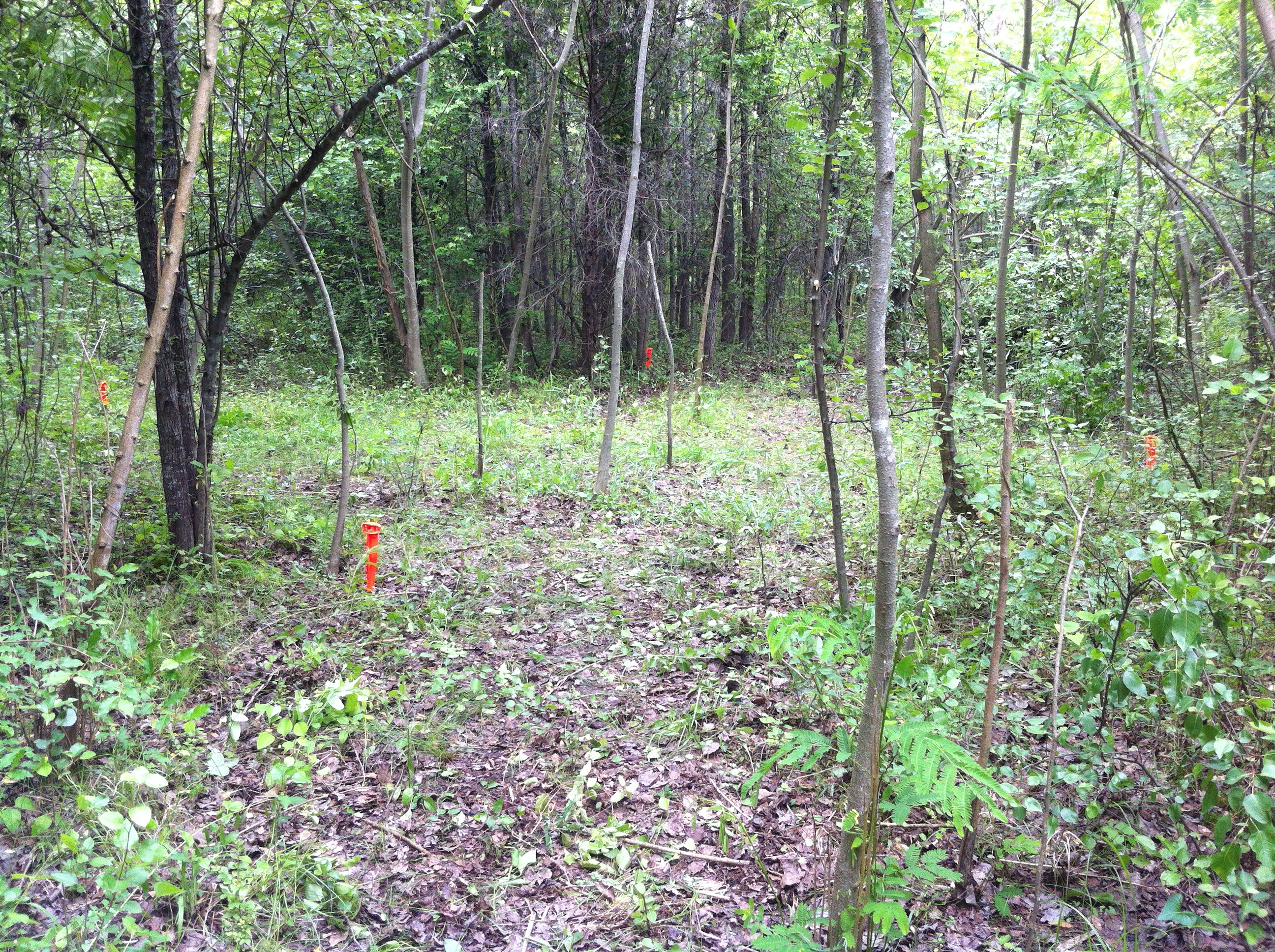
Cabin Site 2-16

Tiny cabin site

Pond picture

A view of the pond

Front Wall Down

While the front wall held up in spite of storms and six inches of rain at the end of November, this time we weren’t quite so lucky. We had hoped to have the side walls framed out and the walls up by December, but the work was going slowly. I often wished I had paid more attention in high school geometry, though thankfully I hadn’t forgotten everything. I think it’s all still in my brain somewhere, beneath fifteen years of other information.

Chuck, meanwhile, figured out how to use the saw to cut boards at a 45 degree angle. But in spite of our successes, the measurements were off for our side walls. We noticed this when the studs were slanting toward each other at the top. We then realized that the base was 2″ wider than the top (116″ vs. 114″), which meant that the boards for the roof pitch were too short. We used the mallet to try to beat one of the side walls into shape, only to have the wall fall apart.

In these situations, it’s better to start over anyway. We figured out where we had gone wrong, and now we just needed to know how much longer the top boards should be. We needed Pythagoras.

Luckily, the sands of time had left the Pythagorean Theorem unburied in my mind: a^2 + b^2 = c^2 .\,  Since we had the distance for “c” (our hypotenuse) and knew that “a” and “b” had to be equal, we were able to calculate the length needed rather than “guesstimating.” 116″ x 116″ (“c” squared) = 13,456 divided by 2 = 6,728, the square root of which is 82″. For some reason, we came up with 82.5″ that day, and it worked.

The walls are nearly finished. We still have to frame out a couple of windows, but then we will be ready to raise the walls. As a precaution now that winter has begun here in Arkansas, we left the front wall down and stacked the other walls on top of it. To ensure that rain would not fill the ruts between studs, we placed OSB board on top and then the tarp.

What we need next are several nice days during which we can finish framing the windows, raise the walls, and start nailing the rafters up to support the walls. Chuck’s Spring Break is seven weeks away, but there’s no guarantee that the first week of March will be lovely, or even remotely conducive to working outdoors. Last year we had a late snow that week.

Until then, we can cut grooves in the rafters, continue planning, and rest up for our next chance!

Side Walls

We were lucky this week to have two beautiful work days. The side walls are partially framed after a good bit of figuring, deductive reasoning, and internet research. I learned what a 12/12 pitch is/looks like as well as how to cut boards at a 45 degree angle. However, I am still not bold enough to do my own cutting. Aside from being slightly terrified (remembering Frost’s poem “Out, Out”), I’m left-handed. The saw is clearly designed for the other 70% of the world.

I do, however, nail. It’s a great stress-reliever, and the metal hammer makes a lovely sound on 3” nails, like a coin hitting water in a fountain. And the pitch changes the further the nail goes in.

But in spite of my love of nailing (or perhaps because of it), I managed to pull a muscle in my armpit. It has spent the past few days randomly cramping and releasing, reminding me that not all things are “mind over matter.”

We had hoped to have all four walls up, but we ran out of 2” x 4” x 12’ boards, which was just as well since we also ran out of steam. We did, however, get the gravel pile moved to what will eventually be the back porch area (courtesy of two helpful teenagers) as well as finished weed-eating a patch of grass invading the neighbor’s yard.

Highlights included thousands of blackbirds flying overhead, finding a rain puddle that might one day make a nice koi pond, and hours of breathing fresh, clean air.

Monday kicks off three days of rain, after which holiday celebrations will fill our days. We’re hoping for rest, too, and dream of a tinier home.

Outdoor Toilet

Friends have been curious about the logistics of building a cabin while not having access to water or electricity. Our power tools are battery-operated, and we charge them at our other home. But what about when we spend the night in our camper, which we don’t currently have a generator for, much less water hookups?

Our Coleman lantern serves us well.

Sometimes we shower at a friend’s.

But there’s one thing we didn’t want to live without: a toilet.

We had a broken chair that Chuck reinforced with boards. He borrowed a jigsaw and cut a hole for a toilet seat. What’s beneath? A bucket with a little peat moss in it—magic, organic material that eliminates odor and helps with the composting.

I admit I was skeptical at first, but days later there is no smell, nor are there flies (and we’ve had some warm days). This potty chair currently sits in a private spot in the woods. We cover the chair with a tarp, but otherwise it’s open to the elements.

Most of us have heard the euphemism “when nature calls,” but an outdoor bathroom brings a whole other level of meaning to that expression.

Tiny Cabin: First Wall

We had three days off before Thanksgiving, and the weather was promising. The flood waters had receded, and our cabin had weathered it all. Schedules cleared, we set our alarms for five thirty each morning and drove an hour to the cabin site. The sun crested the God-forsaken Bradford pears to warm the 36 degree air.

The other days weren’t as cold, but they were breezy and sunless. Warming up wasn’t hard with plenty of gravel to shovel around the foundation. Six more inches of rain would soon be on the way.

Our days began and ended in the dark, a rhythm that my body actually welcomed. We were home by six with just enough energy left to eat, bathe, and fall asleep.

The first order of business was nailing down the sub-floor. If I had it all to do over, I’d buy the more expensive, sturdier boards. However, once the sturdy pallet wood floors are down, we won’t know the difference.

After buying 70+ boards, we began assembling the walls. Luckily, Chuck pays attention to measurements and drawing straight lines. I gave that up a long time ago…

We realized that the 2 ¼” nails weren’t cutting it—nailing one end loosened the other. I’m not sure why we thought they would; the directions were clear: 3 ½” nails. No problems there.

Nailing together the frame took only a matter of minutes. Framing the door and windows, however, required finesse. We had to consider not only the size, but also the placement and height, which meant we needed to know the floor plan. Anticipating this, we had already taped off the size of the cabin in our current living room. That’s right—the tiny cabin is smaller than our current living room!

We spontaneously decided that each door would have a transom window. We built the back wall as well, but we’re waiting to put it up. We covered everything with a 20’ x 30’ tarp and didn’t want it to invite a pond between the two walls.

The hard part now is coordinating time off with good weather. Three consecutive days should be enough to finish the shell, but that depends on forces beyond our control.

Tree Removal

In Robert Frost’s poem “Mending Wall,” his neighbor insists that “good fences make good neighbors.”

Many of us like our boundaries, and a fence is a way to clearly communicate a do-not-cross zone. (We put up our fence a few years ago after I saw one man chasing another with a pistol.) A fence can also keep animals and children corralled as well as offer privacy. But like the fence in “Mending Wall,” they need to be repaired from time to time.

Driveway 5-13-15 after

Driveway 5-13-15

Driveway July 2015

Driveway July 2015

Our neighbor out at the land asked if we could trim or remove the Bradford Pears growing between our driveway and his fence. Limbs were growing over into his yard, and the trees were preventing him from making repairs.

We showed up one morning with that singular purpose: to cut them down. As can be said about most of our work days, we had no idea what we were getting ourselves into.

What at first appeared to be four or five substantial trees growing along our neighbor’s fence line turned out to be 50-60 smaller trees growing in clumps, ready to scourge.Tree Roots

Generously, our neighbors and their kids came out to help. We used the clippers on smaller trees, Chuck chainsawed the larger ones, and we hauled them to the open field, making a brush pile. The sun wasn’t too hot, and after less than five hours we’d taken them all out.

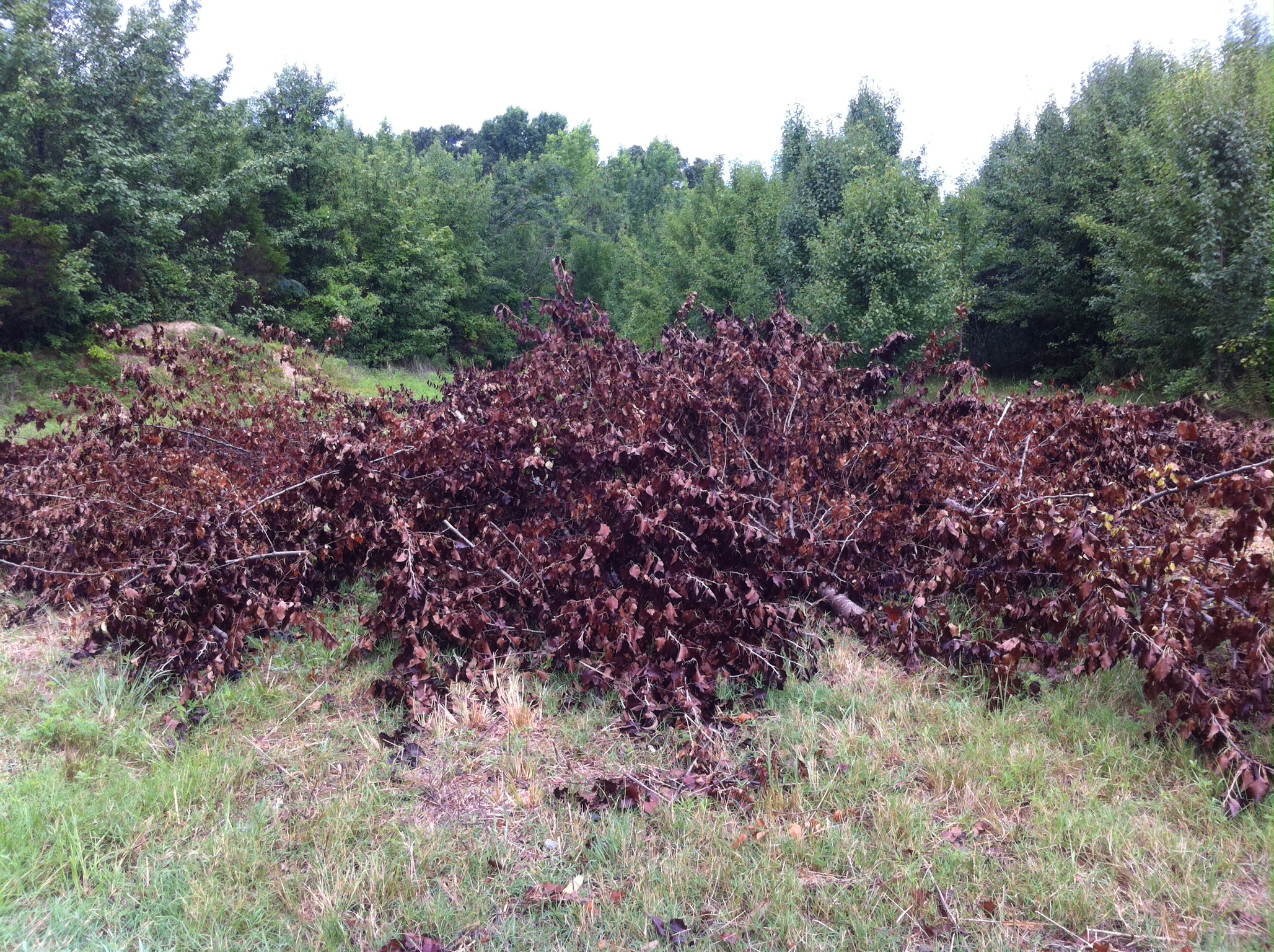
Brush Pile (dried out)

Brush Pile (dried out)

Granted, the brush pile was a little more scattered than we had hoped, but several were simply too heavy to lift and heave on top. The pile is spread out rather than tall, but we plan to trim it up before burning it.

The job isn’t finished, however: all of the little stumps have to go. Otherwise, they’ll just re-sprout from the roots. We’ve bought a mattock to help with that, but it’s all easier said than done.

Our neighbors plan to plant a row of lovely Japanese maples in their place. Good fences make good neighbors, and so do shared tastes.

A Ton of Work…Literally

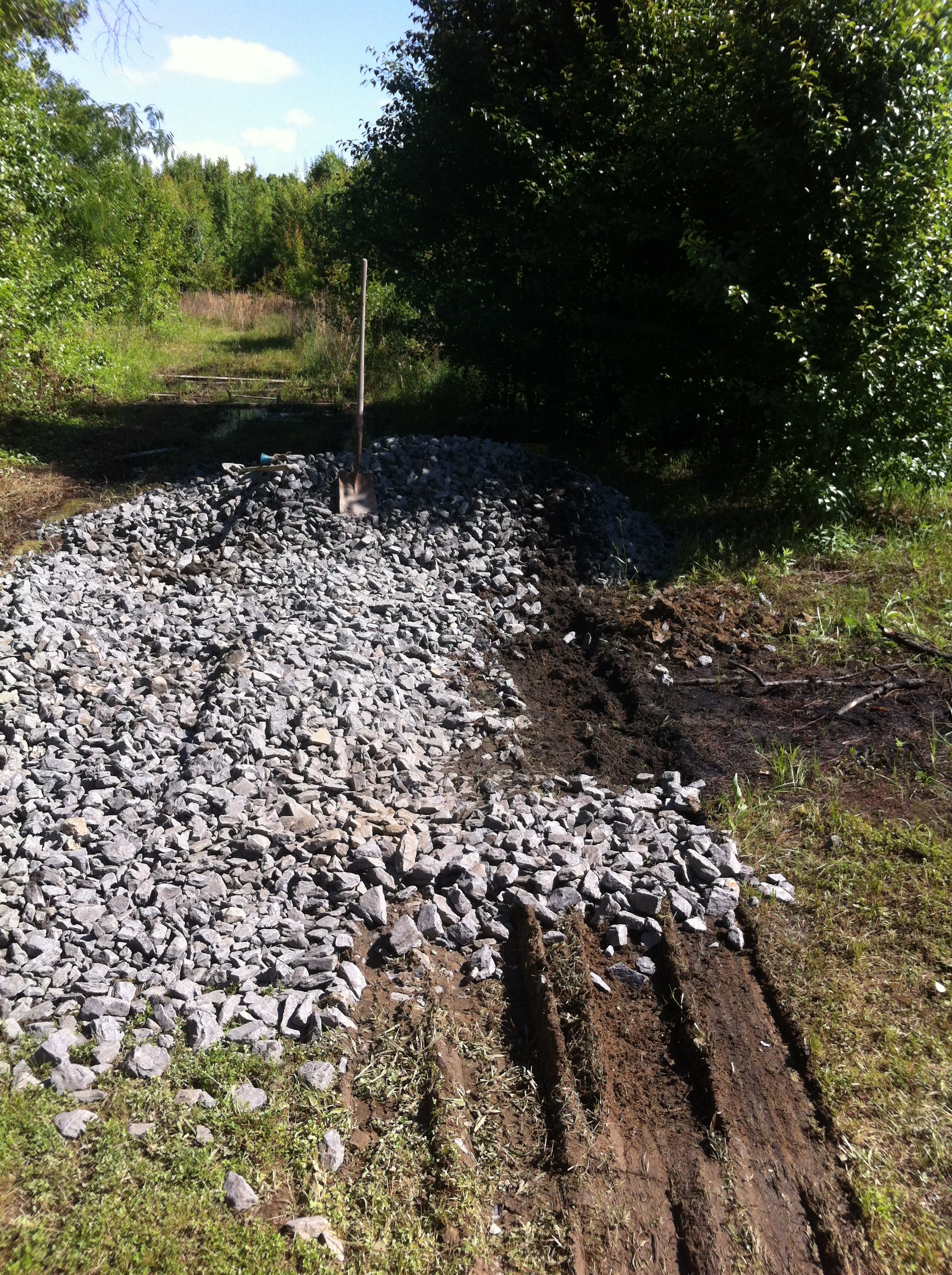
5-22-15 driveway with partial rockA few days after our sinking episode, we called a gravel truck. The problem: because the clay was so soft, he couldn’t gradually release the rock so that it spread evenly. He just had to dump it. While he went for another load, we spread it with shovels, shoes, and gloved hands.

We hadn’t expected anyone to be able to come out on such short notice, much less deliver multiple loads. Otherwise, we might have had more hands on deck! Instead, it was just the two of us. We had planned to spend the day clearing the new site for the cabin, but we knew this had to be done. More rains were on the horizon, and the driveway was basically a 6’ x 22’ mud hole.

The air was cool and the day was lovely, but after spreading the third load we were worn out—and the driveway was only half done.

Then, the mayor of Higginson himself showed up—tall and serious, with a resemblance to Tommy Lee Jones. He was in the neighborhood because around the corner a stretch of houses were having some sewer problems. [With a composting toilet we won’t have to worry about that!]

He exuded silent confidence while sizing up the situation. He told us he’d be back with a backhoe, and five minutes later we watched, mouths agape, as he smoothed out the freshly-dumped load.

5-22-15 driveway with rock

We asked if we could make a donation to the town, but he wouldn’t take any money directly. Instead, he said, “If you want, go to City Hall and make a donation to the 4th of July fund.” He seems to take his civic position as one “for the people.”

Thankfully, our cabin-building schedule was only tentative, or else we’d be behind. At the moment, we’re under a severe thunderstorm warning, and up to five more inches of rain are expected this week. We’ll go out to the land on Thursday to see if our new site is still above water.

The Best Laid Plans of Mice and Men

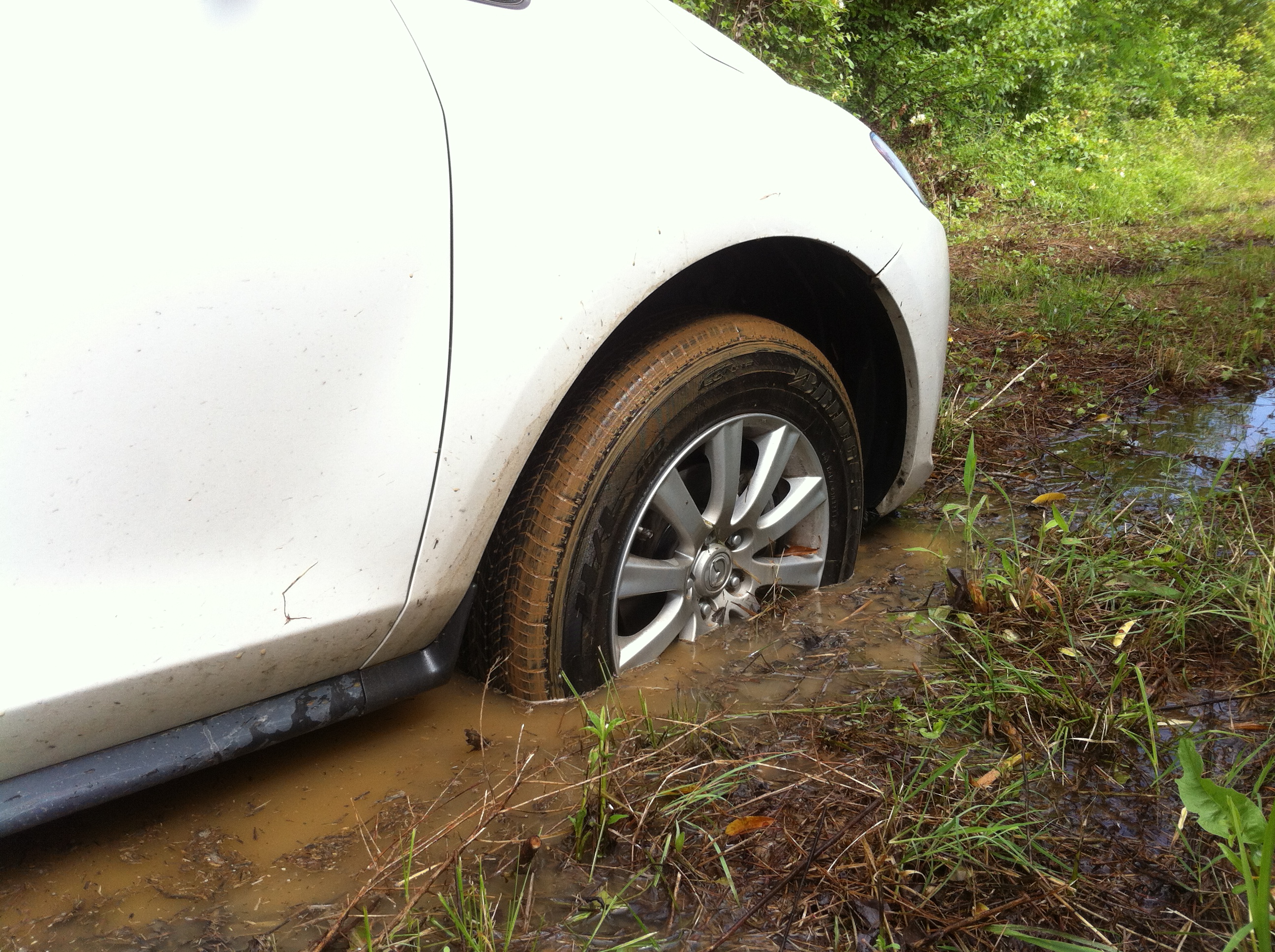
Although the driveway was still pretty wet, we thought we’d push on through in the car and save ourselves the trouble of hauling equipment over the mud puddles.

5-19-15 Car in the mud

In short, we caused ourselves more trouble than we saved.

The title of this post comes from the Robert Burns poem “To a Mouse, On Turning up in Her Nest with the Plough, November, 1785.” He apologizes to the mouse, whose house he has accidentally destroyed at the onset of winter, then philosophizes:

 The best laid schemes o’ Mice an’ Men

Gang aft agley,

An’ lea’e us nought but grief an’ pain,

For promis’d joy!

He then tells the mouse that though she’s unfortunate in the present moment, she’s still luckier than he: humans look back on a difficult past as well as anticipate future hardship.

After over an hour of futile attempts, we were soaked and muddy, spirits dashed. A kind neighbor drove by and pulled us out with a chain. It was a moment of triumph.

We then discovered that with the recent rains, our cabin site had turned into a swamp. To our credit, the house stakes were on the highest ground. Still, our “castle” doesn’t need a moat, so we’re currently looking for a new spot. We probably need more sun for the solar panels anyway.

Looking back on the mistakes we’ve made and knowing that more surprises are no doubt on the way, I can relate to Burns’ poem. But the kindness of strangers, not to mention friends and family, gives me comfort.

Water, Water Everywhere

driveway 5-13-15

Driveway 5-13-15 before

Driveway 5-13-15 after

Driveway 5-13-15 after

We finally made it back to the land today. Searcy has had crazy rain–6-8″ in the past seven days. A portion of the property is under water, but thankfully not where we intend to build the cabin.

Once we build the cabin and set up the rain barrel, we should be able to collect about 8,000 gallons of water a year [~250 sq. ft. of roof x .62 x 50″ annual rainfall = 7,936 gallons].

Cabin Site

Cabin Site

Next week, we’re going to brave the weather and camp on the land. We’ve cleared away all the small trees and brush; now we need a chainsaw. We’ve staked out the spot for the house and have to decide the path for the driveway. Once it’s cleared, we can have a load of gravel brought for the foundation.

Then it’ll be time to start building.

Why a Tiny Home?

Life is too short for housework. Living in a 2400 sq. ft. home with three step-children and three cats, I used to spend at least ten hours a week on housework alone. That was on top of the 40+ hour grind. While earning my M.A. in English and then working as a college instructor, I did a lot of work from home, frequently feeling the tension between a dirty kitchen and a stack of student essays.

I experienced seasonal depression. If the weather outside was nice and I was indoors all day except the length of time it took me to walk to my car, I felt an overwhelming despair. I didn’t recognize the cause for a long time.  But my family can verify: I was irritable and angry.

I reset myself every spring with a week in a tent on Petit Jean Mountain. In 2008, a two-week camping trip to the Southwest—meeting with Hopi and Navajo artists and storytellers—was healing and spiritually orienting.

Now I wonder, “Why immerse myself in nature only one week a year?” The decision to build a tiny house in the woods did not happen overnight, but now I see that I have been evolving toward this lifestyle for a decade. At first it was scary to revise my ideas of success and safety. Then I felt freedom.

Ten more hours a week will be much better spent tending a garden, sitting on the porch, or going fishing. Maybe the next ten years won’t fly by as fast as the last ten did.