Bradford Pears and Clearing the Cabin Spot

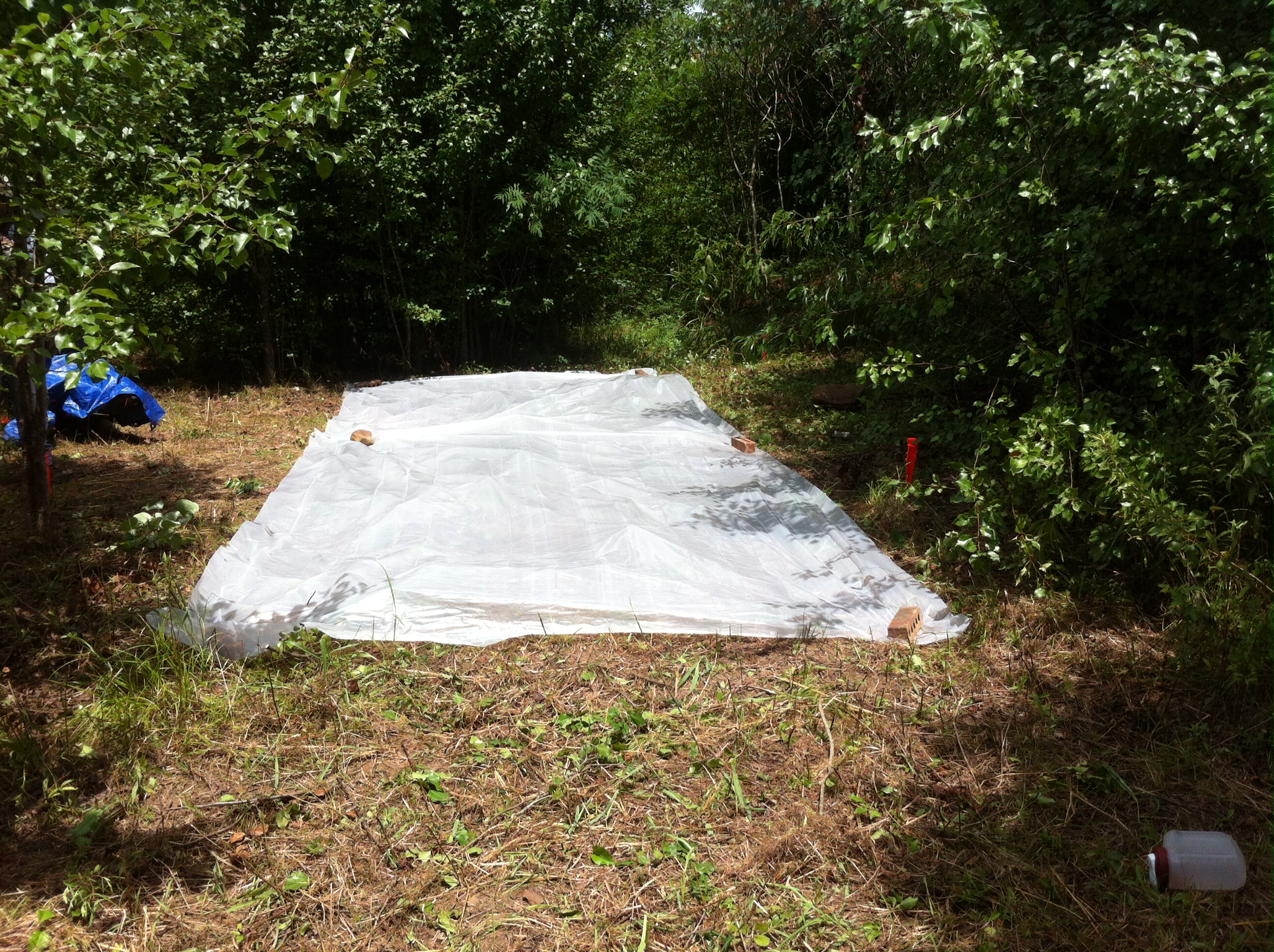
Cabin Spot with Plastic sheetIn the book of Genesis, God tells Adam, “cursed is the ground because of you; in toil you shall eat of it all the days of your life; thorns and thistles it shall bring forth for you.”

And then God created the Bradford Pear, or at least the cross-bred variety covering our land like a plague of locusts.

Imagine if thorny vines grew into trees. Imagine a super-plant that can perniciously sprout out of its own roots and grow in a cluster. Imagine interlocking branches and no smooth surface to grab when dragging them away. Imagine inch-long thorns jabbing arms, legs, and abdomen, leaving a tetanus-shot soreness and a purple bruise.

Granted, in spring they blossom white—they’re lovely if you can get past the stench. In autumn, the leaves are breathtaking shades of red, yellow, and orange. https://en.wikipedia.org/wiki/Pyrus_calleryana

But unless cultivated, they’re literally a thorn in the side.

Nevertheless, we’ve cleared enough to put down a sheet of plastic roughly the dimensions of the tiny cabin. This sheet is 10’ X 25’, and our cabin (with porches) will be 16’ X 22’. We still have to remove some stumps, and the impending rain should work in our favor for once–hopefully softening the ground enough for us to pull them out.
A Ton of Work…Literally

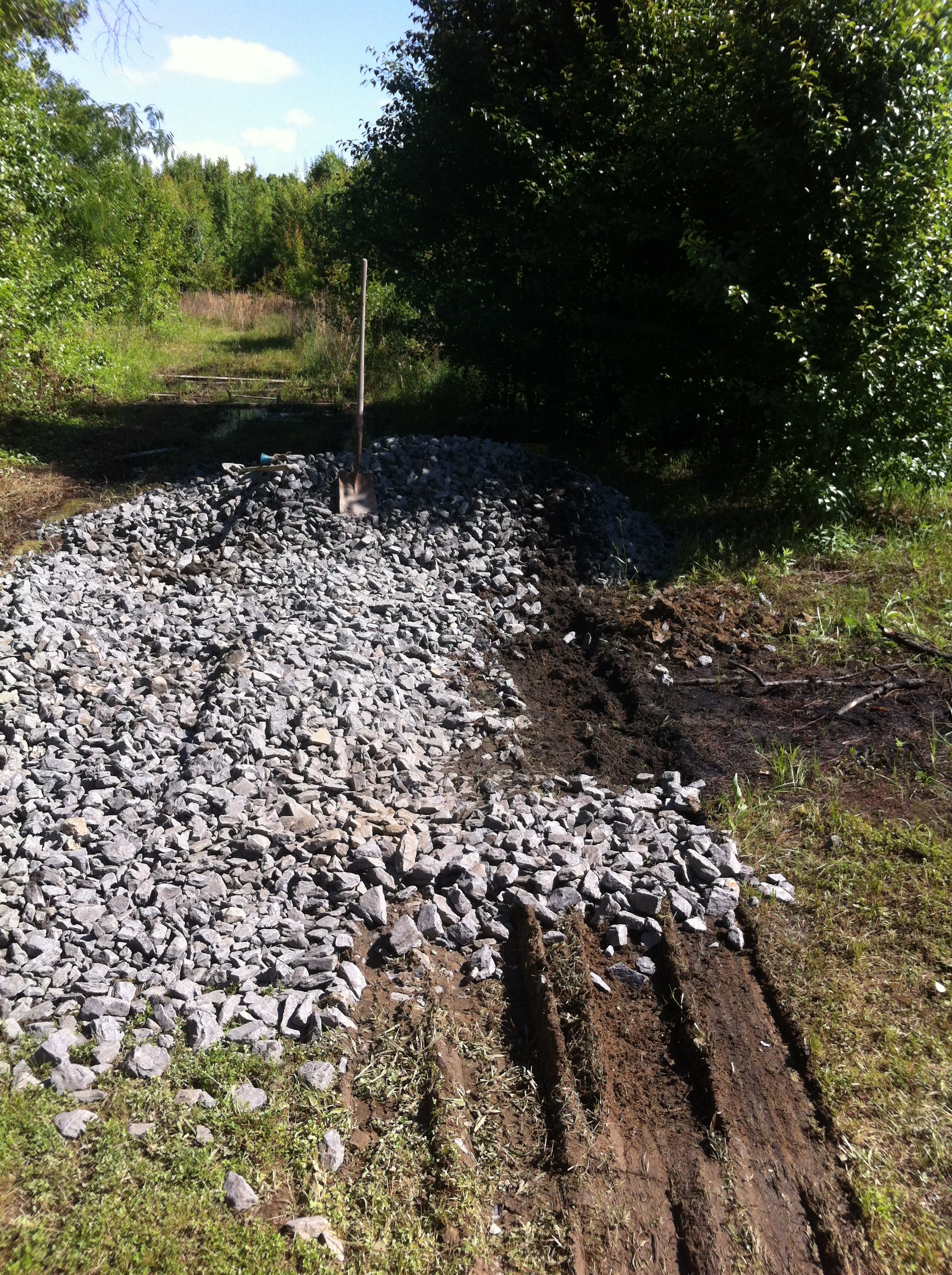
5-22-15 driveway with partial rockA few days after our sinking episode, we called a gravel truck. The problem: because the clay was so soft, he couldn’t gradually release the rock so that it spread evenly. He just had to dump it. While he went for another load, we spread it with shovels, shoes, and gloved hands.

We hadn’t expected anyone to be able to come out on such short notice, much less deliver multiple loads. Otherwise, we might have had more hands on deck! Instead, it was just the two of us. We had planned to spend the day clearing the new site for the cabin, but we knew this had to be done. More rains were on the horizon, and the driveway was basically a 6’ x 22’ mud hole.

The air was cool and the day was lovely, but after spreading the third load we were worn out—and the driveway was only half done.

Then, the mayor of Higginson himself showed up—tall and serious, with a resemblance to Tommy Lee Jones. He was in the neighborhood because around the corner a stretch of houses were having some sewer problems. [With a composting toilet we won’t have to worry about that!]

He exuded silent confidence while sizing up the situation. He told us he’d be back with a backhoe, and five minutes later we watched, mouths agape, as he smoothed out the freshly-dumped load.

5-22-15 driveway with rock

We asked if we could make a donation to the town, but he wouldn’t take any money directly. Instead, he said, “If you want, go to City Hall and make a donation to the 4th of July fund.” He seems to take his civic position as one “for the people.”

Thankfully, our cabin-building schedule was only tentative, or else we’d be behind. At the moment, we’re under a severe thunderstorm warning, and up to five more inches of rain are expected this week. We’ll go out to the land on Thursday to see if our new site is still above water.

The Best Laid Plans of Mice and Men

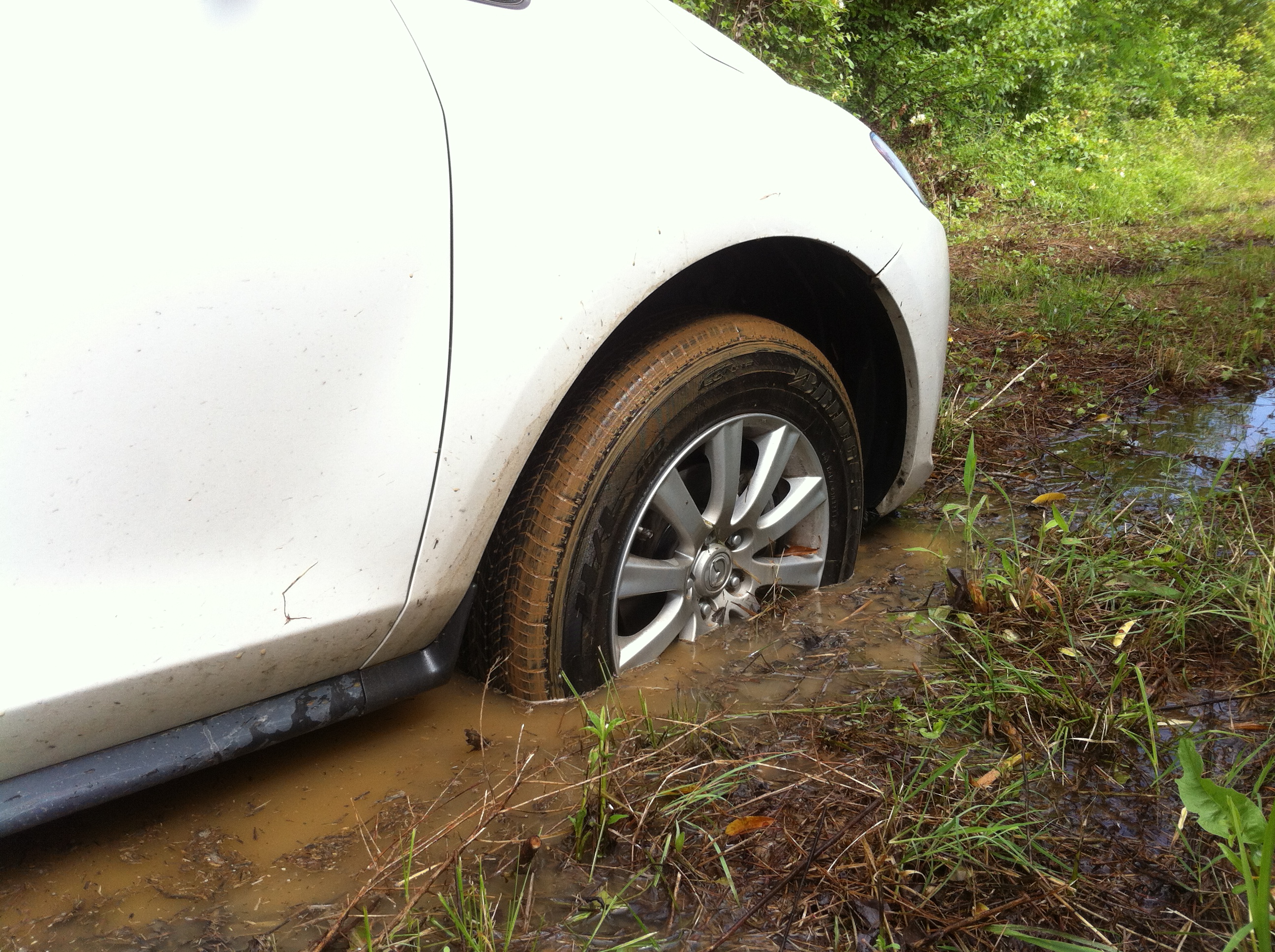
Although the driveway was still pretty wet, we thought we’d push on through in the car and save ourselves the trouble of hauling equipment over the mud puddles.

5-19-15 Car in the mud

In short, we caused ourselves more trouble than we saved.

The title of this post comes from the Robert Burns poem “To a Mouse, On Turning up in Her Nest with the Plough, November, 1785.” He apologizes to the mouse, whose house he has accidentally destroyed at the onset of winter, then philosophizes:

 The best laid schemes o’ Mice an’ Men

Gang aft agley,

An’ lea’e us nought but grief an’ pain,

For promis’d joy!

He then tells the mouse that though she’s unfortunate in the present moment, she’s still luckier than he: humans look back on a difficult past as well as anticipate future hardship.

After over an hour of futile attempts, we were soaked and muddy, spirits dashed. A kind neighbor drove by and pulled us out with a chain. It was a moment of triumph.

We then discovered that with the recent rains, our cabin site had turned into a swamp. To our credit, the house stakes were on the highest ground. Still, our “castle” doesn’t need a moat, so we’re currently looking for a new spot. We probably need more sun for the solar panels anyway.

Looking back on the mistakes we’ve made and knowing that more surprises are no doubt on the way, I can relate to Burns’ poem. But the kindness of strangers, not to mention friends and family, gives me comfort.

Composting Toilet: Not Flushing Your Money Away

When we moved into our current home, each bathroom was its own color: sky blue, bright red, and teal. That included the sink, tub, and toilet. With five people in the house, using the toilet only three times a day, multiplied by an average of four gallons per flush, we used 21,900 gallons of water a year, not including showers, laundry, or dishes.

Over the years we’ve remodeled the bathrooms, replacing the toilets with more efficient ones that use a lot less water. Still, we’re wasting thousands of gallons a year of perhaps the most precious natural resource we have.

This time we’re going with a composting toilet. It is what the name implies: waste, through various chemical processes and a little time, becomes soil.

The low end of composting toilets requires only a bucket and peat moss. A mid-range toilet requires frequent emptying, possibly before the waste has finished composting.

High grade composting toilets are expensive—relatively speaking. The one we are currently looking at http://www.envirolet.com/320.html is around $3,200 (on sale through tomorrow).

That is considerably more than we had wanted to spend (three times the amount of the materials for the shell of our cabin), but it’s still cheaper than a septic tank. And rather than empty the waste ourselves, a solar-powered battery will suck it out of the house and into a composter. The great thing is, it only has to be emptied once a year, after it’s through composting.

Why a Tiny Home?

Life is too short for housework. Living in a 2400 sq. ft. home with three step-children and three cats, I used to spend at least ten hours a week on housework alone. That was on top of the 40+ hour grind. While earning my M.A. in English and then working as a college instructor, I did a lot of work from home, frequently feeling the tension between a dirty kitchen and a stack of student essays.

I experienced seasonal depression. If the weather outside was nice and I was indoors all day except the length of time it took me to walk to my car, I felt an overwhelming despair. I didn’t recognize the cause for a long time.  But my family can verify: I was irritable and angry.

I reset myself every spring with a week in a tent on Petit Jean Mountain. In 2008, a two-week camping trip to the Southwest—meeting with Hopi and Navajo artists and storytellers—was healing and spiritually orienting.

Now I wonder, “Why immerse myself in nature only one week a year?” The decision to build a tiny house in the woods did not happen overnight, but now I see that I have been evolving toward this lifestyle for a decade. At first it was scary to revise my ideas of success and safety. Then I felt freedom.

Ten more hours a week will be much better spent tending a garden, sitting on the porch, or going fishing. Maybe the next ten years won’t fly by as fast as the last ten did.

Tiny Cabin

My husband Chuck and I are building a tiny cabin this summer on seven acres with a pond just outside of Searcy, Arkansas. I’m looking forward to breathing fresh air and living more sustainably.

We have a little experience with carpentry, but this will be our first ground-up project. The “Thoreau cabin” will be 10′ x 16′ with a loft. We’re also adding a small front porch and a screened-in back porch. Though we still have some details to work out, we’re going off-grid, using solar power and rain water.

We purchased the plans from solarcabin–watch his 3-minute video for the “Thoreau cabin” here: https://www.youtube.com/watch?v=NTT5kC4V54o

Tomorrow we begin clearing the chosen spot. The car is loaded with shovels, a wheelbarrow, weed eaters, bug spray. and a first aid kit. What we bought: tarp, rope, gloves, clippers, stakes, a straw hat.

May in Arkansas is lovely. The weather should be great, though there’s a 20% change of a “stray thunderstorm.” Even so, it’s all part of the adventure!