Side Walls

We were lucky this week to have two beautiful work days. The side walls are partially framed after a good bit of figuring, deductive reasoning, and internet research. I learned what a 12/12 pitch is/looks like as well as how to cut boards at a 45 degree angle. However, I am still not bold enough to do my own cutting. Aside from being slightly terrified (remembering Frost’s poem “Out, Out”), I’m left-handed. The saw is clearly designed for the other 70% of the world.

I do, however, nail. It’s a great stress-reliever, and the metal hammer makes a lovely sound on 3” nails, like a coin hitting water in a fountain. And the pitch changes the further the nail goes in.

But in spite of my love of nailing (or perhaps because of it), I managed to pull a muscle in my armpit. It has spent the past few days randomly cramping and releasing, reminding me that not all things are “mind over matter.”

We had hoped to have all four walls up, but we ran out of 2” x 4” x 12’ boards, which was just as well since we also ran out of steam. We did, however, get the gravel pile moved to what will eventually be the back porch area (courtesy of two helpful teenagers) as well as finished weed-eating a patch of grass invading the neighbor’s yard.

Highlights included thousands of blackbirds flying overhead, finding a rain puddle that might one day make a nice koi pond, and hours of breathing fresh, clean air.

Monday kicks off three days of rain, after which holiday celebrations will fill our days. We’re hoping for rest, too, and dream of a tinier home.

Tiny Cabin: First Wall

We had three days off before Thanksgiving, and the weather was promising. The flood waters had receded, and our cabin had weathered it all. Schedules cleared, we set our alarms for five thirty each morning and drove an hour to the cabin site. The sun crested the God-forsaken Bradford pears to warm the 36 degree air.

The other days weren’t as cold, but they were breezy and sunless. Warming up wasn’t hard with plenty of gravel to shovel around the foundation. Six more inches of rain would soon be on the way.

Our days began and ended in the dark, a rhythm that my body actually welcomed. We were home by six with just enough energy left to eat, bathe, and fall asleep.

The first order of business was nailing down the sub-floor. If I had it all to do over, I’d buy the more expensive, sturdier boards. However, once the sturdy pallet wood floors are down, we won’t know the difference.

After buying 70+ boards, we began assembling the walls. Luckily, Chuck pays attention to measurements and drawing straight lines. I gave that up a long time ago…

We realized that the 2 ¼” nails weren’t cutting it—nailing one end loosened the other. I’m not sure why we thought they would; the directions were clear: 3 ½” nails. No problems there.

Nailing together the frame took only a matter of minutes. Framing the door and windows, however, required finesse. We had to consider not only the size, but also the placement and height, which meant we needed to know the floor plan. Anticipating this, we had already taped off the size of the cabin in our current living room. That’s right—the tiny cabin is smaller than our current living room!

We spontaneously decided that each door would have a transom window. We built the back wall as well, but we’re waiting to put it up. We covered everything with a 20’ x 30’ tarp and didn’t want it to invite a pond between the two walls.

The hard part now is coordinating time off with good weather. Three consecutive days should be enough to finish the shell, but that depends on forces beyond our control.

Building the Tiny Cabin Frame

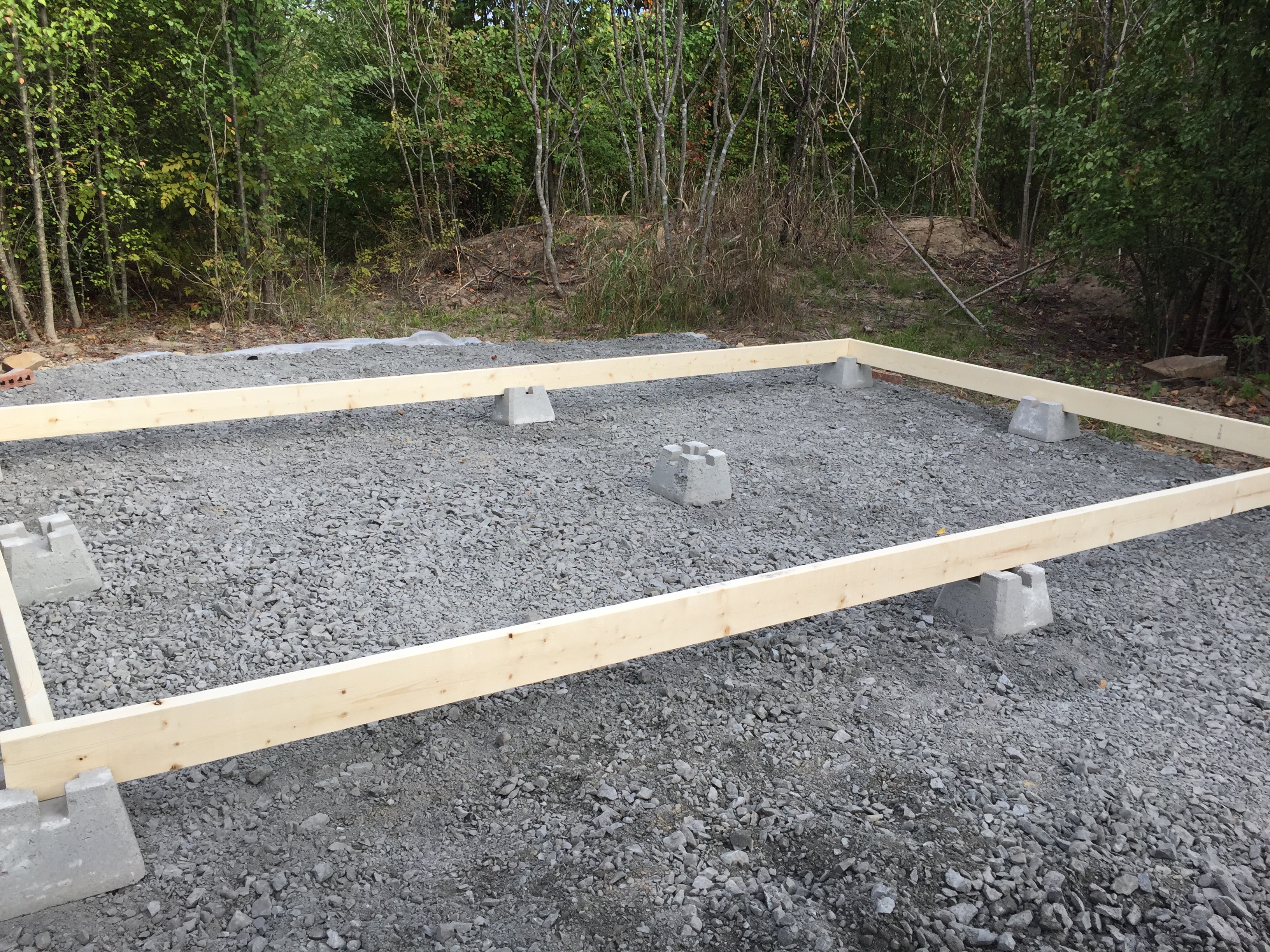
The plans we have require nine deck blocks ($6.22 each/$55.98 total), two 2’ x 6’ x 16’s ($9/$18), and thirteen 2’ x 6’ x 10’s ($5.39/$70.07). We had spread the gravel, but we knew that the surface wasn’t level. So, once we set out the deck blocks, we not only had to make sure that the deck block itself was level, but that it was the same height as the other eight. The back right corner seemed to be higher than the rest, so we decided to make that one the measure. We knew the guesswork would take a while, but it is absolutely essential that the blocks be even. It’s worth the time and effort.

Building Materials: boards, joist hangers, insulation, and chicken wire

Building Materials: boards, joist hangers, deck block insulation, and chicken wire

We added gravel to raise the back left corner and then put a 2’ x 4’ x 16’ board between them. We then placed the level on the middle of the board. If the bubble lined up, we knew they were the same height. We were surprisingly good at judging how much gravel to add to make the four pillars the same, but the deck blocks themselves were rarely level on all four sides (the smaller the space to level, the more difference one millimeter makes). Chuck raised the heavy block while I added anything from stones to a fine layer of gravel dust. We also had to make sure that the surface was packed down well to reduce the chances of the block shifting.

First Nails

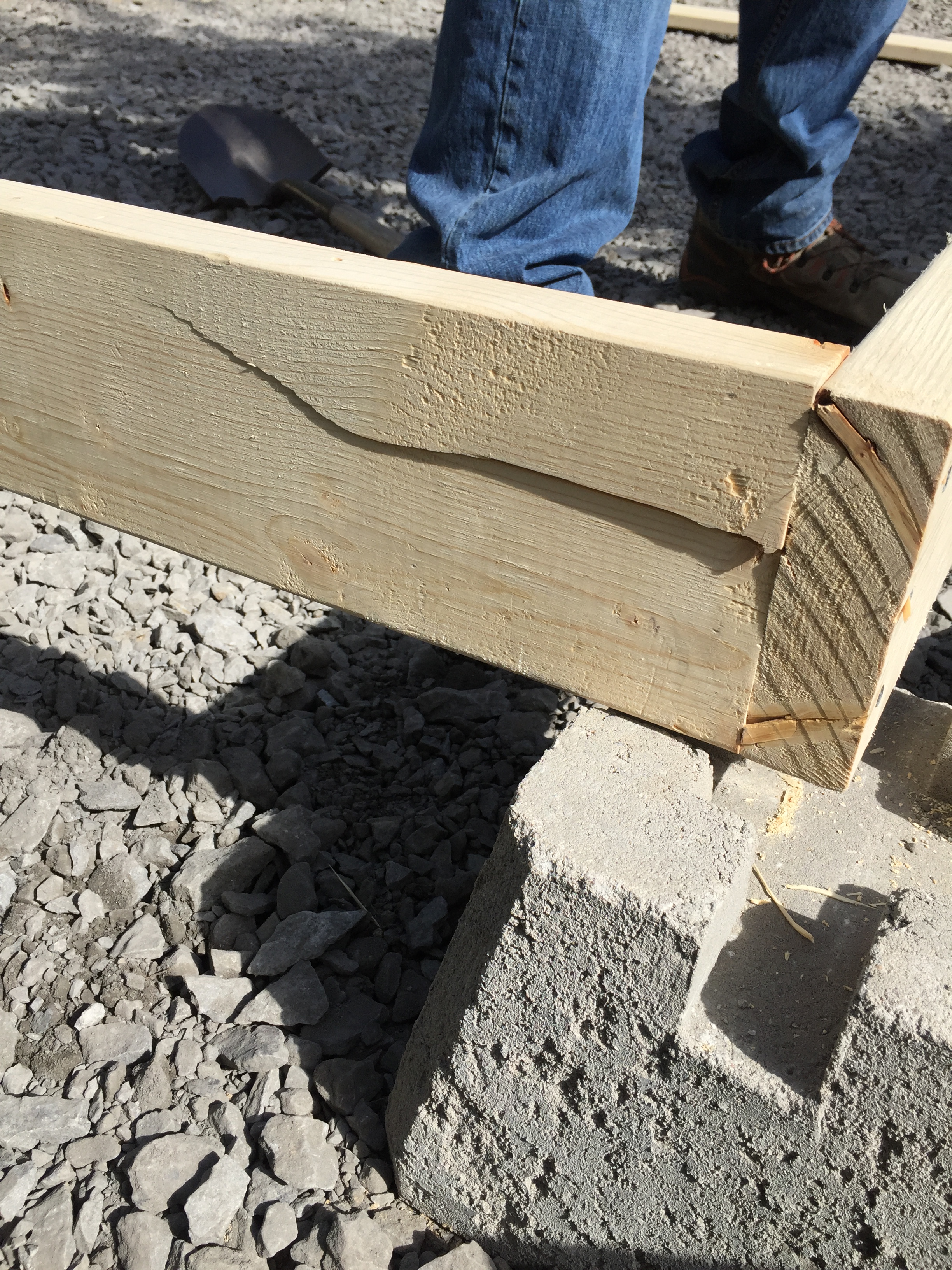
It was time to nail the boards together. We started with the same back corner. Chuck drilled holes first to make driving the nails easier. I held the boards and flush as possible as he nailed. We repeated the process until we had finished the outside perimeter. One of the boards split—the nail probably hit a knot in the wood—so Chuck reinforced it on the outside with additional nails. We might have replaced it altogether had the other end of it not already been nailed to the back board.

Luckily, it's not as bad as it looks.

Luckily, it’s not as bad as it looks.

We then used the square (an L-shaped ruler) to make sure the boards had gone together at a perfect right angle, which is harder than one might think. I held the long end of the ruler flush against the 2’ x 4’ x 16’, which we had decided was the board by which the angle would be measured. In a perfect angle, the short end of the L would fit perfectly up against the other board. In our case, however, the end of the ruler made contact with the board, preventing the rest of the ruler from making contact. It was about a millimeter off.

All is not lost when this happens. Chuck took the rubber mallet and hit the wood while I held it tight (obviously, we didn’t want to hit the wood while it was sitting in the carefully-placed deck block). The mallet bends the wood ever so slightly, and we were able to get more of the square flush against the board. It wasn’t perfect, though. Still, all is not lost: later, when we nail the plywood (or OSB) down to the frame, it will help cinch the discrepancies.

Cabin Frame

Between crouching, lifting, and concentrating, we were pretty worn out by the time we finished, nearly five hours after we started. We had hoped to put in all the cross-beams, but instead we had to cover them with the tarp and leave them for another day.

Bradford Pears and Clearing the Cabin Spot

Cabin Spot with Plastic sheetIn the book of Genesis, God tells Adam, “cursed is the ground because of you; in toil you shall eat of it all the days of your life; thorns and thistles it shall bring forth for you.”

And then God created the Bradford Pear, or at least the cross-bred variety covering our land like a plague of locusts.

Imagine if thorny vines grew into trees. Imagine a super-plant that can perniciously sprout out of its own roots and grow in a cluster. Imagine interlocking branches and no smooth surface to grab when dragging them away. Imagine inch-long thorns jabbing arms, legs, and abdomen, leaving a tetanus-shot soreness and a purple bruise.

Granted, in spring they blossom white—they’re lovely if you can get past the stench. In autumn, the leaves are breathtaking shades of red, yellow, and orange. https://en.wikipedia.org/wiki/Pyrus_calleryana

But unless cultivated, they’re literally a thorn in the side.

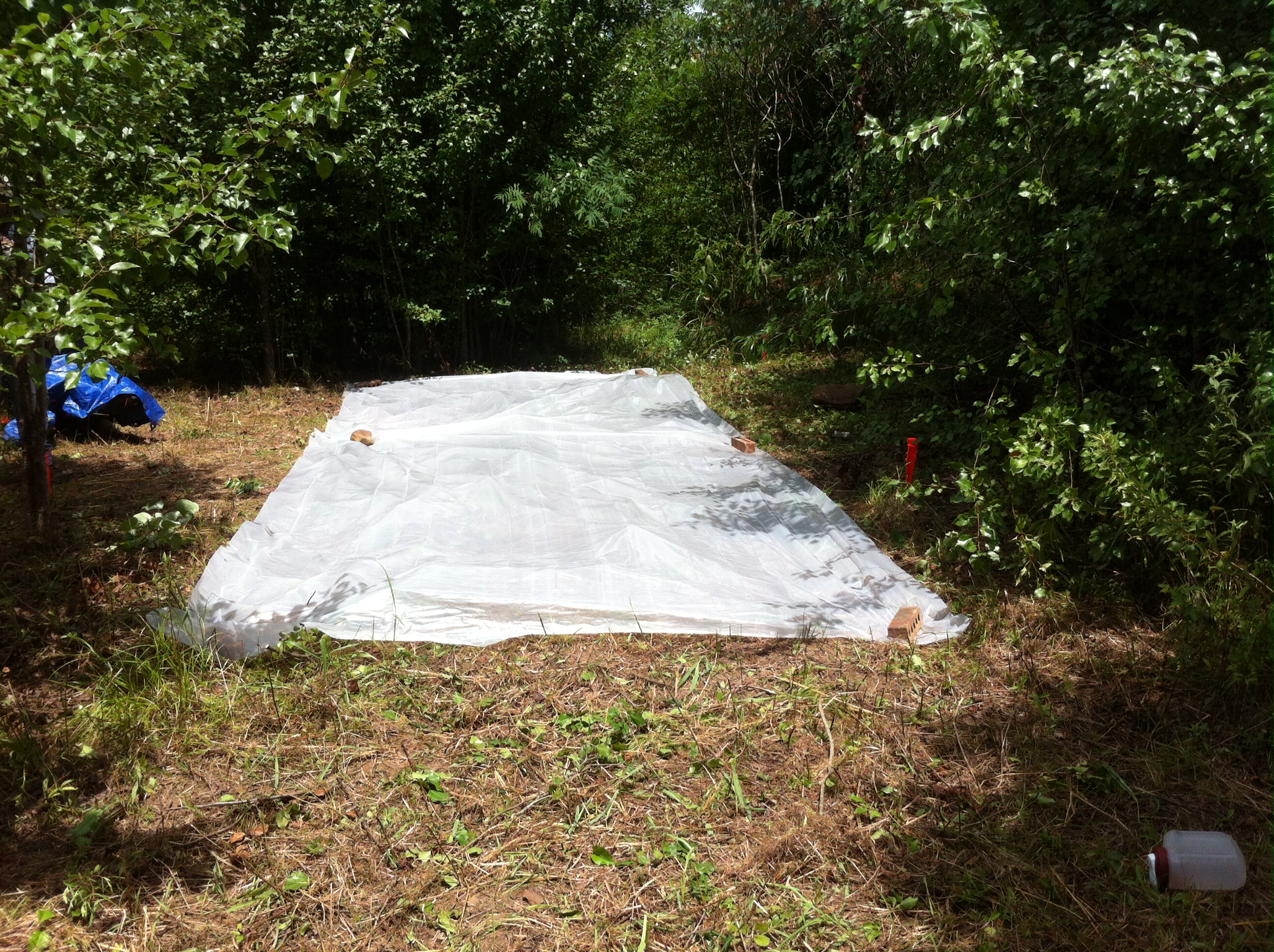
Nevertheless, we’ve cleared enough to put down a sheet of plastic roughly the dimensions of the tiny cabin. This sheet is 10’ X 25’, and our cabin (with porches) will be 16’ X 22’. We still have to remove some stumps, and the impending rain should work in our favor for once–hopefully softening the ground enough for us to pull them out.