Tiny Cabin Update: Roof!

Chuck’s Uncle Bobby and his cousin Scott arrived at 8 am after a three-hour drive from northwest Arkansas ready to roof the tiny cabin.

The first order of business (after the hugs and handshakes) was to finish nailing the decking. Bobby and Scott then suggested screwing 2″ x 4″s along each seam to prevent sagging. Chuck cut the boards, Bobby held them to the inside of the roof, and Scott used his battery-powered drill to screw them in. The rest of us–my stepson Geoffrey, his girlfriend Angel, and I–tried to make ourselves useful.

The shade dwindled like a receding tide. We felt beached beneath the hot sun. Though the day originally promised to be “partly cloudy,” we were only lucky enough to have five glorious minutes of cloud cover around 1 pm. I was hot, so I could only imagine how Scott and Bobby felt.

I would like to say that our heroic roofers enjoyed frequent breaks in the shade, but they toughed it out. Bobby–two days shy of 61–was up and down the extension ladder helping with the drip edge, the tar paper, and the first row of shingles. Scott worked higher up and along the steep edges. We handed Bobby shingles, and he took them to Scott. Someone was always holding a ladder.

Though I mostly admired their handiwork from the ground, it was enthralling to watch them roof. Of course, I was nervous with Scott up so high. I could tell he knew what he was doing, but he wasn’t overconfident. Though he and Bobby cracked jokes to lighten the mood, they were both serious when it came to safety. In this situation, safety meant awareness–an art almost lost in our modern world of buzzing phones and constant distraction.

By a quarter to noon, they had finished the back. The air was really heating up, and the humidity didn’t help. But with the drip edge done and their system perfected, the front side only took less than an hour and a half to complete.

By now, fair-skinned Angel was resting in the shade. Geoffrey cut the 54 shingles for the peak, and Scott had them nailed in no time.
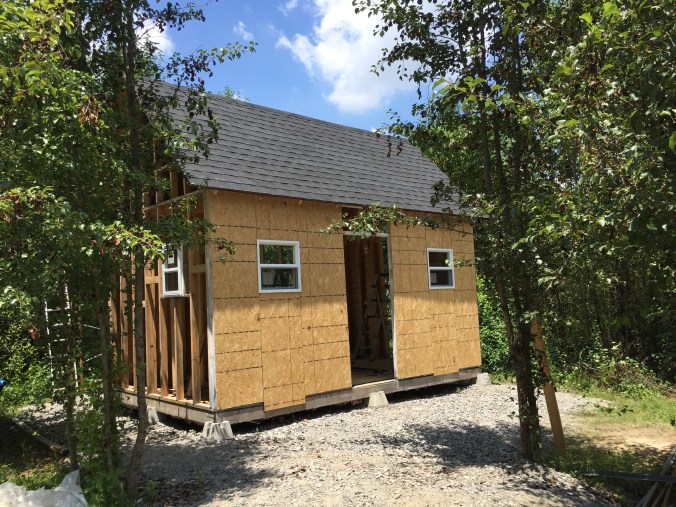
Tiny Cabin Roof Finished

With Chuck’s arm still recovering coupled with our lack of expertise, we were glad to have called in professionals. But even more than that, we were glad to be with family.

Front Wall Down

While the front wall held up in spite of storms and six inches of rain at the end of November, this time we weren’t quite so lucky. We had hoped to have the side walls framed out and the walls up by December, but the work was going slowly. I often wished I had paid more attention in high school geometry, though thankfully I hadn’t forgotten everything. I think it’s all still in my brain somewhere, beneath fifteen years of other information.

Chuck, meanwhile, figured out how to use the saw to cut boards at a 45 degree angle. But in spite of our successes, the measurements were off for our side walls. We noticed this when the studs were slanting toward each other at the top. We then realized that the base was 2″ wider than the top (116″ vs. 114″), which meant that the boards for the roof pitch were too short. We used the mallet to try to beat one of the side walls into shape, only to have the wall fall apart.

In these situations, it’s better to start over anyway. We figured out where we had gone wrong, and now we just needed to know how much longer the top boards should be. We needed Pythagoras.

Luckily, the sands of time had left the Pythagorean Theorem unburied in my mind: a^2 + b^2 = c^2 .\,  Since we had the distance for “c” (our hypotenuse) and knew that “a” and “b” had to be equal, we were able to calculate the length needed rather than “guesstimating.” 116″ x 116″ (“c” squared) = 13,456 divided by 2 = 6,728, the square root of which is 82″. For some reason, we came up with 82.5″ that day, and it worked.

The walls are nearly finished. We still have to frame out a couple of windows, but then we will be ready to raise the walls. As a precaution now that winter has begun here in Arkansas, we left the front wall down and stacked the other walls on top of it. To ensure that rain would not fill the ruts between studs, we placed OSB board on top and then the tarp.

What we need next are several nice days during which we can finish framing the windows, raise the walls, and start nailing the rafters up to support the walls. Chuck’s Spring Break is seven weeks away, but there’s no guarantee that the first week of March will be lovely, or even remotely conducive to working outdoors. Last year we had a late snow that week.

Until then, we can cut grooves in the rafters, continue planning, and rest up for our next chance!

Building the Tiny Cabin Frame

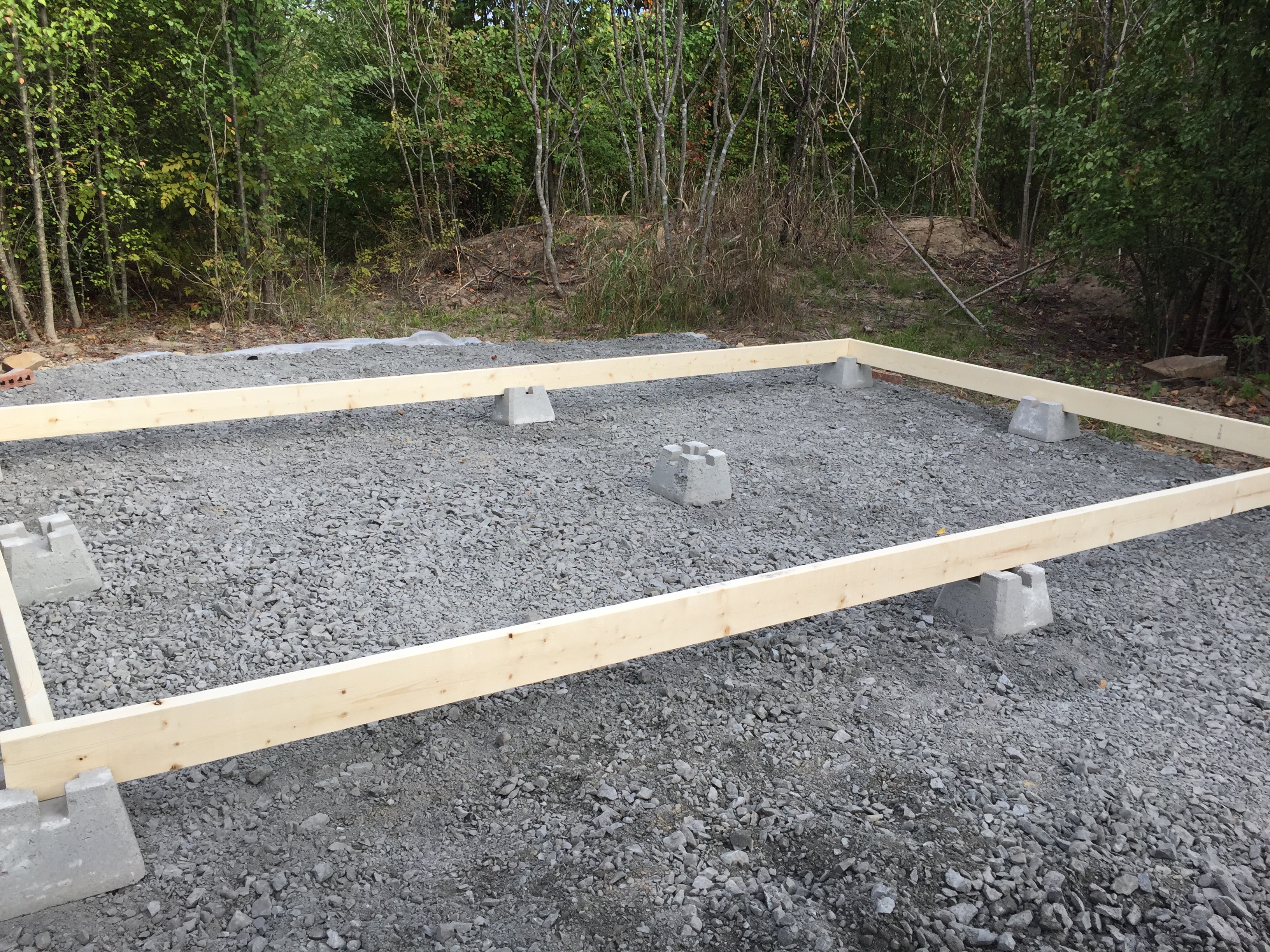
The plans we have require nine deck blocks ($6.22 each/$55.98 total), two 2’ x 6’ x 16’s ($9/$18), and thirteen 2’ x 6’ x 10’s ($5.39/$70.07). We had spread the gravel, but we knew that the surface wasn’t level. So, once we set out the deck blocks, we not only had to make sure that the deck block itself was level, but that it was the same height as the other eight. The back right corner seemed to be higher than the rest, so we decided to make that one the measure. We knew the guesswork would take a while, but it is absolutely essential that the blocks be even. It’s worth the time and effort.

Building Materials: boards, joist hangers, insulation, and chicken wire

Building Materials: boards, joist hangers, deck block insulation, and chicken wire

We added gravel to raise the back left corner and then put a 2’ x 4’ x 16’ board between them. We then placed the level on the middle of the board. If the bubble lined up, we knew they were the same height. We were surprisingly good at judging how much gravel to add to make the four pillars the same, but the deck blocks themselves were rarely level on all four sides (the smaller the space to level, the more difference one millimeter makes). Chuck raised the heavy block while I added anything from stones to a fine layer of gravel dust. We also had to make sure that the surface was packed down well to reduce the chances of the block shifting.

First Nails

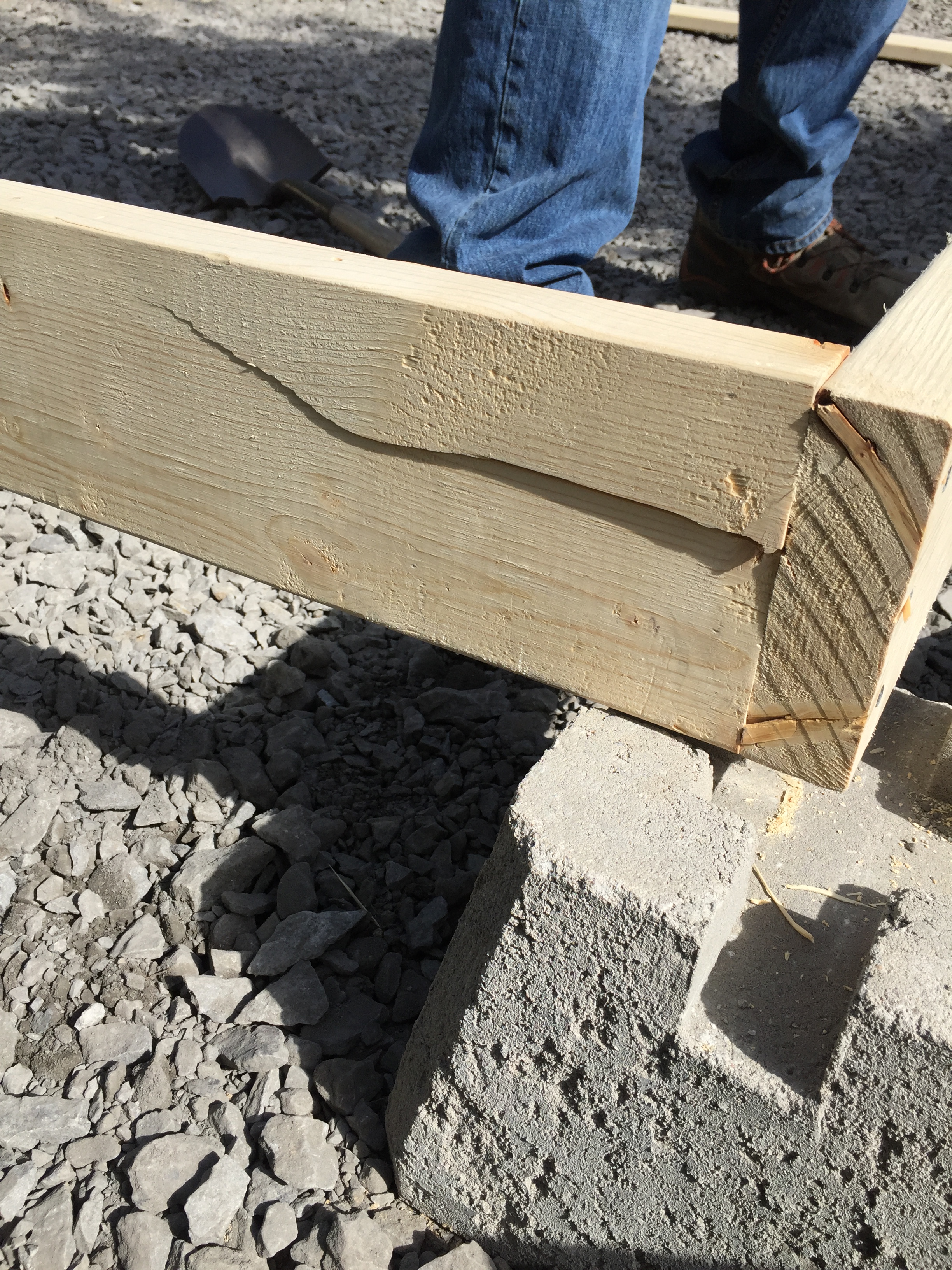
It was time to nail the boards together. We started with the same back corner. Chuck drilled holes first to make driving the nails easier. I held the boards and flush as possible as he nailed. We repeated the process until we had finished the outside perimeter. One of the boards split—the nail probably hit a knot in the wood—so Chuck reinforced it on the outside with additional nails. We might have replaced it altogether had the other end of it not already been nailed to the back board.

Luckily, it's not as bad as it looks.

Luckily, it’s not as bad as it looks.

We then used the square (an L-shaped ruler) to make sure the boards had gone together at a perfect right angle, which is harder than one might think. I held the long end of the ruler flush against the 2’ x 4’ x 16’, which we had decided was the board by which the angle would be measured. In a perfect angle, the short end of the L would fit perfectly up against the other board. In our case, however, the end of the ruler made contact with the board, preventing the rest of the ruler from making contact. It was about a millimeter off.

All is not lost when this happens. Chuck took the rubber mallet and hit the wood while I held it tight (obviously, we didn’t want to hit the wood while it was sitting in the carefully-placed deck block). The mallet bends the wood ever so slightly, and we were able to get more of the square flush against the board. It wasn’t perfect, though. Still, all is not lost: later, when we nail the plywood (or OSB) down to the frame, it will help cinch the discrepancies.

Cabin Frame

Between crouching, lifting, and concentrating, we were pretty worn out by the time we finished, nearly five hours after we started. We had hoped to put in all the cross-beams, but instead we had to cover them with the tarp and leave them for another day.

Bradford Pears and Clearing the Cabin Spot

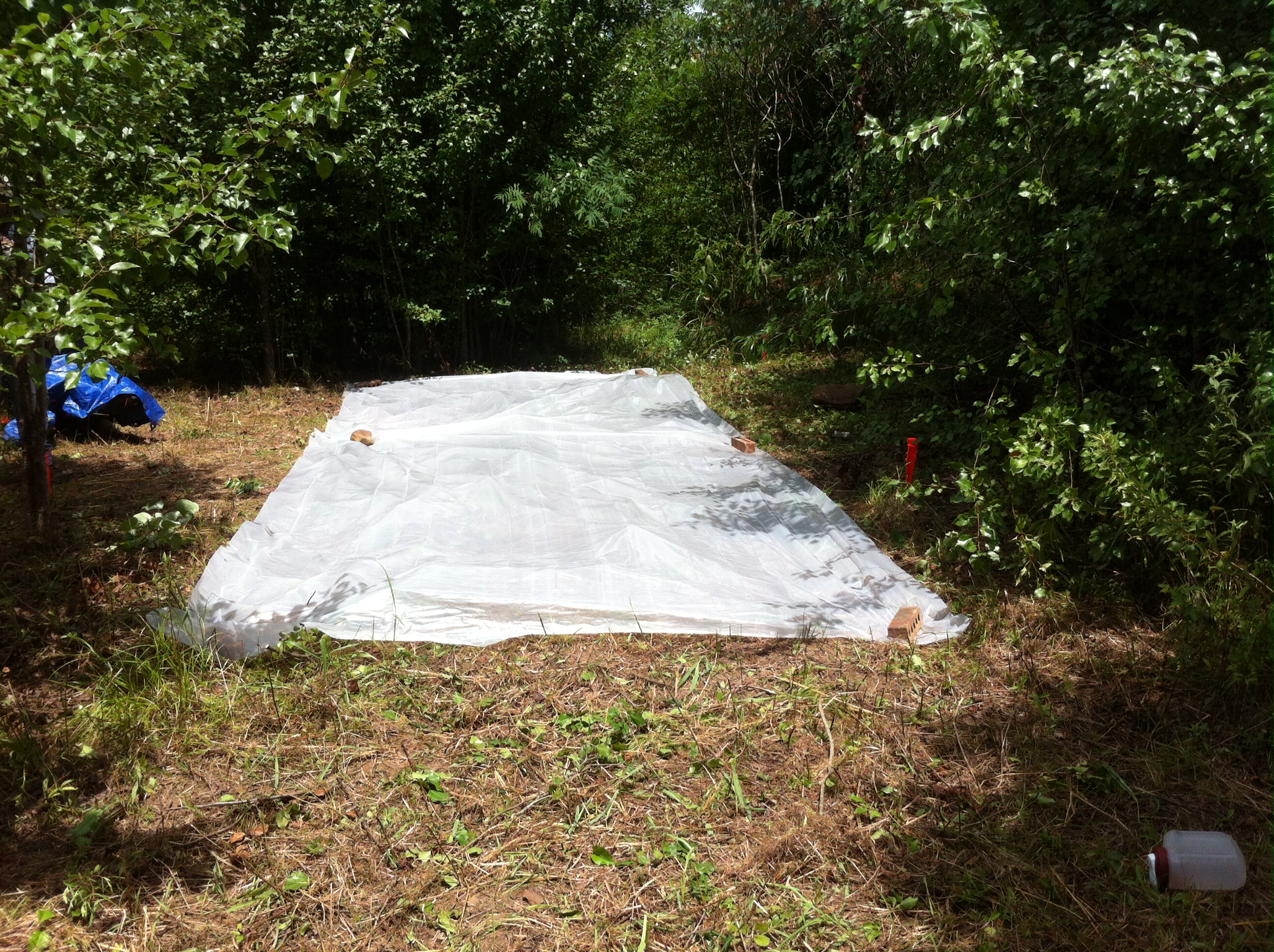
Cabin Spot with Plastic sheetIn the book of Genesis, God tells Adam, “cursed is the ground because of you; in toil you shall eat of it all the days of your life; thorns and thistles it shall bring forth for you.”

And then God created the Bradford Pear, or at least the cross-bred variety covering our land like a plague of locusts.

Imagine if thorny vines grew into trees. Imagine a super-plant that can perniciously sprout out of its own roots and grow in a cluster. Imagine interlocking branches and no smooth surface to grab when dragging them away. Imagine inch-long thorns jabbing arms, legs, and abdomen, leaving a tetanus-shot soreness and a purple bruise.

Granted, in spring they blossom white—they’re lovely if you can get past the stench. In autumn, the leaves are breathtaking shades of red, yellow, and orange. https://en.wikipedia.org/wiki/Pyrus_calleryana

But unless cultivated, they’re literally a thorn in the side.

Nevertheless, we’ve cleared enough to put down a sheet of plastic roughly the dimensions of the tiny cabin. This sheet is 10’ X 25’, and our cabin (with porches) will be 16’ X 22’. We still have to remove some stumps, and the impending rain should work in our favor for once–hopefully softening the ground enough for us to pull them out.

Letting Go as an Act of Faith

Let me be clear: I have a LOT of stuff. I keep things because I think I’ll need them at some point. Or better yet, I tell myself that the Styrofoam container or rubber band from the broccoli will one day be upcycled for some creative purpose.

I can be a hoarder sometimes.

Except that I’ve been living in Gainesville with only a carload of possessions. Now, three years later, I’m back with the stuff I mainly didn’t miss while away. I missed people (and cats), not things.

I still like my stuff. It’s a huge, fleecy blanket I feel safe in.

I was never a Girl Scout, but I wholly subscribed to the motto of being prepared for everything all the time. That is, until I realized a dark motive—the need to be in control.

I wanted to believe that with enough planning, I could prevent disaster. I could hide in preparedness, in distractions—anything to avoid shining a light on that underlying fear. I was terrified of the buzz of busy-ness dying down, of having the security blanket yanked away.

Letting go of things has become, for me, an exercise in acknowledging that I have enough—more than enough. That things will be all right. Or that if something terrible happens, there was nothing I could have done anyway.

That there is only love, and this moment.

Why a Tiny Home?

Life is too short for housework. Living in a 2400 sq. ft. home with three step-children and three cats, I used to spend at least ten hours a week on housework alone. That was on top of the 40+ hour grind. While earning my M.A. in English and then working as a college instructor, I did a lot of work from home, frequently feeling the tension between a dirty kitchen and a stack of student essays.

I experienced seasonal depression. If the weather outside was nice and I was indoors all day except the length of time it took me to walk to my car, I felt an overwhelming despair. I didn’t recognize the cause for a long time.  But my family can verify: I was irritable and angry.

I reset myself every spring with a week in a tent on Petit Jean Mountain. In 2008, a two-week camping trip to the Southwest—meeting with Hopi and Navajo artists and storytellers—was healing and spiritually orienting.

Now I wonder, “Why immerse myself in nature only one week a year?” The decision to build a tiny house in the woods did not happen overnight, but now I see that I have been evolving toward this lifestyle for a decade. At first it was scary to revise my ideas of success and safety. Then I felt freedom.

Ten more hours a week will be much better spent tending a garden, sitting on the porch, or going fishing. Maybe the next ten years won’t fly by as fast as the last ten did.